
Jump to section
- The Undergraduate Degree
- The Curriculum
- The Foundations Program
- Majors and Minors
- Electives
- Progress Towards the Degree
- Definition of a Credit Hour
The Undergraduate Degree
Assumption students are expected to review all academic policies by reading the Academic Catalog, consult with their academic advisors, visit the academic advising site in Brightspace, and regularly review their degree audits, called “My Progress” in Student Planning, the University’s online advising and registration system.
The Academic Catalog is subject to change by the University at any time without notice. University regulations are policy statements to guide students, faculty, and administrators in achieving the goals of the institution and protecting the integrity of the degree. The appropriate authorities with the interest of the students and the institution in mind will make necessary interpretations of these policies. Students should consult their academic advisor, a department chair, the Registrar, or the Provost if they have questions about a policy. Students are bound by the Academic Catalog in place at the time of their matriculation. To receive a degree, an undergraduate student must satisfactorily complete all requirements described in the Academic Catalog in effect at the time of their enrollment as a degree-seeking, matriculated student at the University. Exceptions to these policies may be necessitated by changes in course offerings, degree programs, or by action of authorities other than the University. In that event, every effort will be made to avoid penalizing the student.
All students must complete a minimum of 120 semester hours of University credit with a minimum of 38 courses. No course of fewer than three credits may count toward the 38 courses required for graduation. The one exception is for those one-credit music performance courses (Chorale, Band, Jazz Ensemble, String Camerata), which can be counted as a single 3-credit course. No more than 10 courses may carry grades of D-, D, or D+. Any course beyond the tenth will not count as a course or for credit, but the grade will be reflected in the GPA. The 120 hours required for graduation shall include no more than nine semester hours of practicum and internship, unless required by the major or special program sponsored by the University, such as an international internship or study away experience. For completion of degree, students must fulfil all Foundations Program and major requirements stipulated in the Academic Catalog and Advising Guide of their year of matriculation, earn a Grade Point Average (GPA) of at least 2.0 both cumulatively and in the major program of study. Minor programs of study, though valuable, are not required for degree completion. Minors must be completed with a 2.0 GPA or higher.
Once a student has matriculated at Assumption, no more than four (4) courses taken at another accredited institution may be used to satisfy degree requirements. Students are expected to fulfill Foundations Program and major requirements in residence, with the exception of credits granted at the time of matriculation or through special programs such as study abroad. A maximum of two courses may be taken outside the university to satisfy Foundations Program requirements. Forum courses must be taken at Assumption. At least one half of all courses, 60 of 120 credits, must be taken in residence during fall, spring, intersession, or summer terms or through the Higher Education Consortium of Central Massachusetts (HECCMA).
The Curriculum
The undergraduate curriculum is composed of three categories of courses: those in the Foundations Program, those in a major program of study, and general elective courses. Students must complete the Foundations Program and at least one major program of study to complete the degree. Minor programs of study are not required.
The Foundations Program
Assumption is a ‘comprehensive Catholic liberal arts institution’ because it offers all students an education that is rooted in an approach to the liberal arts informed by the Catholic intellectual tradition. It is a ‘comprehensive Catholic liberal arts institution’ because it offers students an education that extends to the pursuit of specialized knowledge, vocational preparation, and pre-professional studies.
All majors, minors, and programs at Assumption share its mission of providing students with an education that awakens ‘a sense of wonder, discovery, and purpose’ in students, and all majors, minors, and programs contribute to Assumption’s work of ‘forming graduates known for their intellectual seriousness, thoughtful citizenship, and devotion to the common good.’ However, there is an important difference between Catholic liberal arts education, on one hand, and specialized knowledge, vocational preparation, and pre-professional studies, on the other. In a comprehensive institution, specialized knowledge, vocational preparation, and pre-professional studies are important, and they find their principal home in majors and minors. Catholic liberal arts education is also important, and it finds its home principally in the Foundations Program.
While the two elements of an Assumption education are different, they are also related and complementary. On one hand, the Catholic liberal arts education that students receive in Foundations enables them to approach their majors, minors, careers, and lives in a uniquely thoughtful way. On the other hand, the specialized knowledge, vocational preparation, and pre-professional studies that students pursue in their majors and minors give them an opportunity to apply the perspectives, skills, and habits of mind developed in Foundations in ways that illuminate the concrete relevance of Catholic liberal arts education in and for a meaningful career and a fulfilling life. The dynamic interplay between Assumption’s Foundations Program and its various majors and minors is the heart and soul of an Assumption education—it is what makes an Assumption education uniquely vibrant, significant, and valuable.
Catholic Liberal Arts Education and the Foundations Program
Liberal arts education is education in and for freedom. Liberal arts education aims to liberate students from their attachment to unquestioned assumptions, unconscious prejudices, and unexamined beliefs so that they become capable of free and open inquiry that seeks the true, the good, and the beautiful in all domains of human life. One of the earliest and most influential articulations of the nature and significance of liberal education is the “Allegory of the Cave” in Plato’s Republic, in which Socrates describes the process of philosophic education as a liberation from the chains of unquestioned opinion that makes possible an enlightening ascent to an ever more adequate understanding of reality and morality. Following Plato, Roman thinkers argued that the serious study of the seven liberal arts (grammar, logic, rhetoric, arithmetic, geometry, astronomy, and music) is the most effective way to promote a liberating education. Eventually, these classical outlooks were integrated into the Catholic intellectual tradition. With the rise of the medieval university in Europe, theology emerges alongside philosophy as its counterpart, and together, these disciplines—and their different ways of exploring the relationship between faith and reason—become the twin cornerstones of Catholic liberal arts education. With the advent of the modern world and the rise of modern science, the university underwent an evolution in the eighteenth and nineteenth centuries, and the disciplines we now call ‘the humanities’ emerged as complements to philosophy and theology. In the first half of the 20th century, American Catholic liberal arts colleges and universities worked to synthesize the Catholic intellectual tradition’s emphasis on the foundational role of philosophy and theology for liberal arts education with the modern recognition of the value of other humanistic disciplines. Subsequently, in the second half of the twentieth-century additional efforts were made to create more comprehensive and inclusive approaches to Catholic liberal arts education that incorporate the natural and social sciences.
This historical account provides crucial background for understanding the nature, purpose, and structure of Assumption’s Foundations Program. The Foundations Program articulates the framework through which Assumption provides its students with a Catholic liberal arts education. The Foundations Program’s goal is to further the pursuit of the truth through existentially meaningful humanistic inquiry that explores fundamental questions of value and meaning in a way that liberates students to seek the true, the good, and the beautiful.
The Mission of the Foundations Program
The Foundations Program provides Assumption students with a Catholic liberal arts education that prepares them for thoughtful and meaningful engagement with their majors and minors, their co-curricular activities, their careers, and their lives more broadly. Enlivened by the Catholic affirmation of the harmony of faith and reason, Foundations immerses students in multiple modes of inquiry as they boldly seek the true, the good, and the beautiful wherever they can be found. By encouraging the pursuit of truth in the company of friends, Foundations helps students to develop academically, emotionally, personally, and spiritually. In these ways, the Foundations Program furthers Assumption University’s mission of forming graduates known for intellectual seriousness, thoughtful citizenship, and devotion to the common good.
The Structure of the Foundations Program
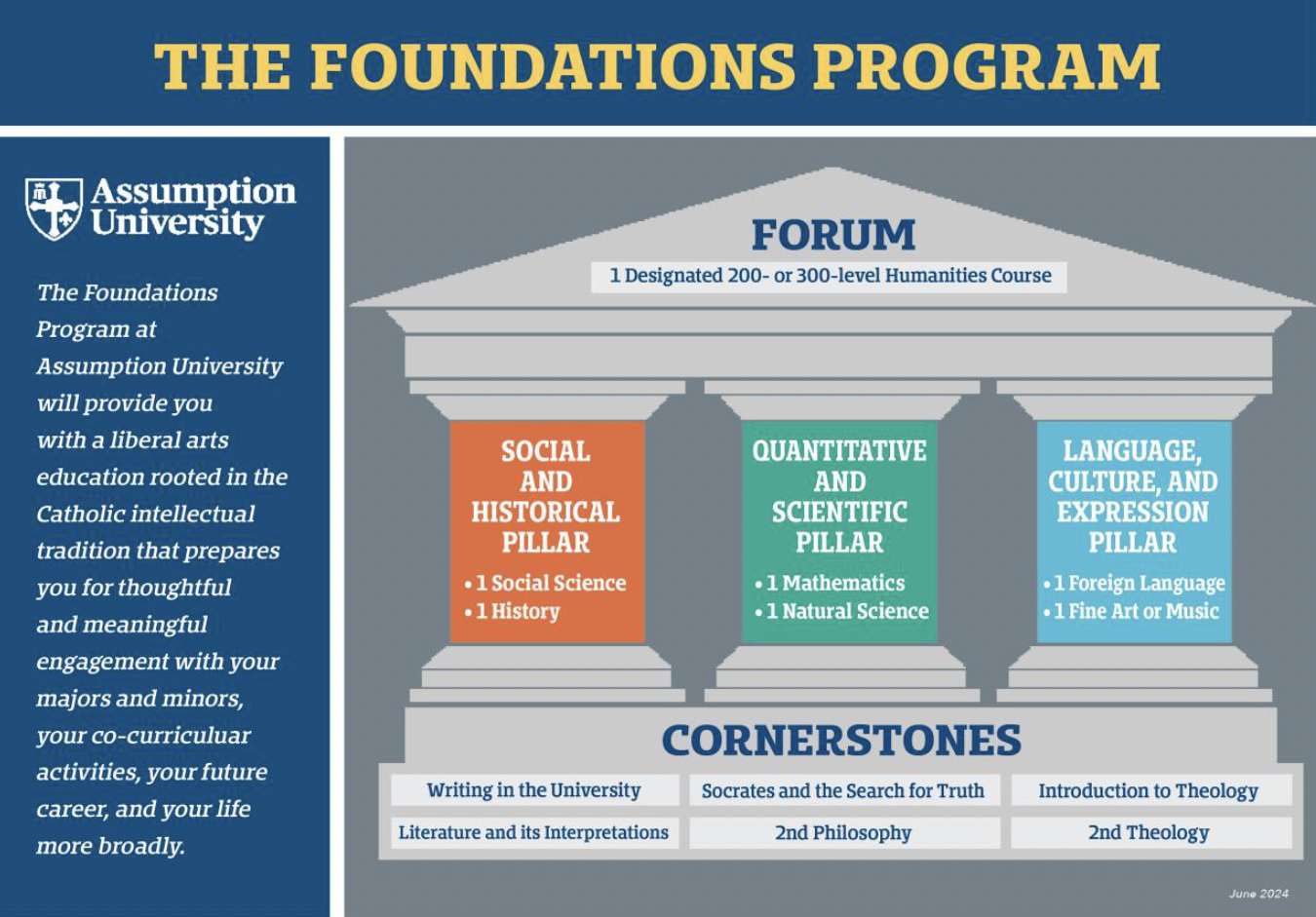
Cornerstones: In Cornerstone courses, you will explore fundamental questions of value and meaning by examining literary, philosophical, and theological investigations of the human condition. These courses place special emphasis on helping you develop the arts of reading, writing, thinking, and conversing.
Pillars: Pillar courses complement Cornerstone courses by leading you to pursue concrete and empirical investigations that attend to the dynamism, diversity, and development of human beings and the social, cultural and natural worlds we inhabit.
- The Language, Culture and Expression Pillar will lead you in an exploration of patterns of meaning in languages, cultures, and the arts, helping you cultivate mutual understanding and a sense of the diversity and beauty of human expression.
- The Quantitative and Scientific Pillar will provide you with a mathematical foundation and understanding of scientific inquiry, enabling you to appreciate the value of mathematics and natural sciences as human activities.
- The Social and Historical Pillar will help you to situate human behavior within its historical and social contexts, empowering you to further understand the value and diversity of human experience.
Forum: Forum courses build on Cornerstone and Pillar courses by giving you the opportunity to pursue your studies beyond the introductory level in a discipline that you find especially fascinating. Your Forum course will lead you to examine an enduring question and/or formative debate that has shaped a particular discipline, helping you develop a deeper appreciation of that discipline’s nature and its significance within the modern world. Forum courses include course offerings from Art History, English, History, Modern and Classical Languages and Cultures, Philosophy, Political Science, and Theology. Forum courses cannot double-count with your major but may double-count with your minor or with a second major.
Learning Goals for the Foundations Program
| Pillars | Goal |
|---|---|
| Cornerstones | You will engage in thoughtful reflection about weighty human concerns in search of what is true, what is good, and what is beautiful by reading, analyzing, and interpreting works of literature, philosophy, and theology, and understanding and practicing the forms of inquiry characteristic of literary, philosophical, and theological investigations of the human condition. You will engage in rational discourse and develop the arts of reading, writing, thinking, and conversing by understanding others’ views and the reasons for them and articulating your own views and giving reasons for them. |
| Language, Culture, and Expression Pillar | You will further your understanding of the diversity and beauty of human expression by identifying patterns of meaning in language and art, creating meaning through art and/or in a language other than English, and exploring cultural dimensions of our complex world. |
| Quantitative and Scientific Pillar | You will further your understanding of mathematics and the natural sciences as valuable human activities by applying mathematical methods, models, and strategies to solve problems, utilizing methods and tools employed by the natural sciences, and describing and understanding processes at work in nature. |
| Social and Historical Pillar | You will further your understanding of how and why human behavior is situated in its social, political, and historical contexts by analyzing interactions between individuals and social and political forces over time, examining how and why organizations, institutions, communities, and/or movements create and change practices, rules, policies, and/or laws, and evaluating practices, rules, policies, and/or laws that govern particular organizations, institutions, communities, and/or movements. |
| Forum | You will further your understanding of one humanistic discipline and this discipline’s significance by analyzing an enduring question and/or formative debate, understanding how and why this question and/or debate develops over time, and exploring how this question and/or debate relates to your life and the contemporary world. You will further your understanding of how and why primary sources shape and illuminate enduring questions and/or formative debates in the humanities by investigating how a particular humanistic discipline understands and uses primary sources and analyzing one or more primary sources to explain how they shape the humanistic discipline you are studying. |
Ideally, students should complete all six Cornerstone courses by the end of their sophomore year. Because Forum courses build on Cornerstone and Pillar courses, students should complete most Cornerstone and Pillar Courses before taking their Forum course. Ideally, students take their Form course in the junior or senior year. Courses that fulfill specific Foundations requirements can be found on the Academic Advising Brightspace site, updated regularly.
Majors and Minors
Major Programs of Study
The purpose of the major is to allow students to develop greater depth and competence in their field of interest. A departmental major must require at least nine courses. Over 14 courses in a single discipline will not count as courses and credits toward graduation, but grades will be included in the cumulative GPA. The major grade point average is calculated using the first successfully completed course that fulfills a requirement. Once the major is completed, further eligible courses in the major will be calculated into the cumulative grade point average only. Students are expected to declare a major by early in the spring semester of their sophomore year.
Double Majors
Double majors require careful planning. Students considering two majors should ask themselves: what is the value of the second major, and how does it link to the first? Would a minor field of study serve my needs? Am I prepared to give up free electives in order to complete a double major? Am I certain I would have time to complete a second major? Have I consulted my academic advisor? Applications to apply for a double major are available online via the Registrar’s office. The first major must be declared before submitting a double major form.
Double Counting
At least three courses taken for a minor must be distinct from those courses taken for a major or a concentration. A minimum of six courses for each major must be distinct from those courses taken for another major or concentration. No double counting is permitted within the Foundations Program. Courses taken that fulfill Foundations requirements may, if eligible, also count in major and/or minor programs of study. Forum Foundations course, may not count in a first major, but may count in a second major or minor program of study.
Special Majors and Minors
Individually-designed major or minor programs of study may be arranged. Interested students should first meet with the their advisor. A form outlining the proposed course of study must be completed by the student and approved by the relevant department chair(s). Paperwork must be submitted to the Registrar’s Office no later than the end of the junior year.
Minor Programs of Study
A minor consists of at least 18 credits and must be completed with a 2.0 or higher grade point average. At least three (3) courses in a minor must be distinct from those in a major program of study. Special minor programs of study are available; see the procedure for special majors above. Minor programs are available in most majors and in Community Service Learning; Core Texts and Enduring Questions (CTEQ); Physics; Engineering Science, Sports Management, Law, Ethics, and Constitutional Studies (LEX); Women’s Studies; and Racial and Ethnic Studies.
Electives
Electives exemplify the liberal arts ideal of study undertaken freely for the enrichment of the human mind. These are courses “elected” or chosen by a student purely to explore fields of interest and enrichment, independent of any requirement. Electives count towards the 120 credits required for completion of the degree. Students may use electives to strengthen their majors and/or minors with coursework in different but related areas.
Progress Towards the Degree
Students are expected to register for and successfully complete an average of fifteen (15) credit hours per semester in order to complete the required 120 credits for graduation within eight semesters. Students who register for fewer than 15 credits, or who fail or withdraw from a course, may fall behind in their progress toward degree completion. Students are responsible for making up any credit-hour deficiency through departmentally approved summer, intersession, or sixth-course enrollment during the fall or spring semester, as applicable.
Courses taken outside the standard fall and spring tuition package may result in additional charges to the student.
For purposes of enrollment status, twelve (12) credit hours constitute full-time undergraduate enrollment. Students enrolled in fewer than twelve (12) credit hours are considered part-time. Students who enroll in fewer than 12 credit hours must:
- File a part-time status form with the Registrar at the beginning of the semester;
- Understand that they may not be eligible for on-campus housing;
- Understand that they will not be eligible for Dean's List;
- Have their financial aid funding reduced or eliminated; and
- Understand that they may not be eligible for health insurance coverage through a parent's plan, depending on the requirements of the applicable plan.
Definition of a Credit Hour
Whether for graduate or undergraduate credit, for each hour of credit earned, Assumption requires fifty minutes of faculty instruction and two hours of student preparation per week for the fifteen weeks of the semester for a total of 42.5 hours of engagement required per earned credit. A 3-credit course, for example, includes a minimum of 2.5 hours of faculty instruction and 6 hours of student preparation each per week in a 15-week semester. This standard applies to the fall and spring 15-week semesters, and to the accelerated summer terms. Classes held three times a week on Monday, Wednesday, and Friday are 50 minutes long; twice-weekly Tuesday/Thursday classes are 75 minutes in duration. This standard is applied in the awarding of labs, practica, internships for credit, studio work, or other academic work completed as part of an academic program of study.